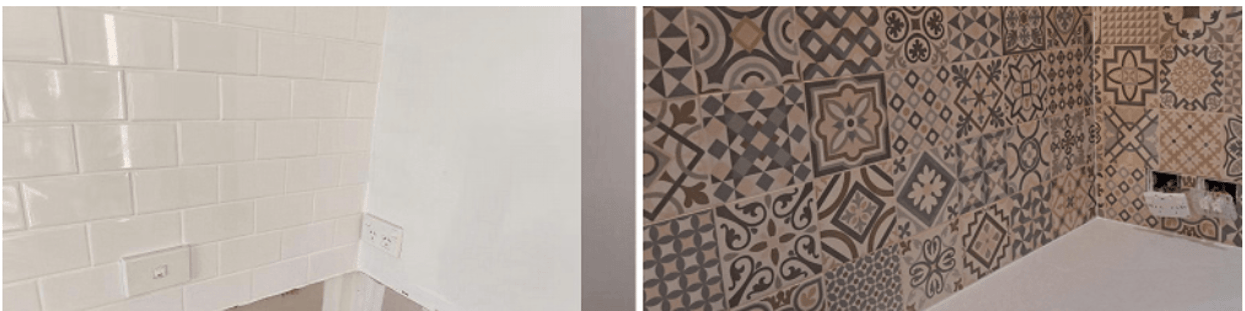
Kitchen SplashbackComplex geometry and the desire for repeat tiles to not be detectable made this a challenging project
Splashback tiling in the kitchen and laundry - Kelburn
The problem: Complex geometric tiles with little room for error
As part of a major home renovation, the owners of this character 1920s Kelburn home recognized that, if done well, splashback tiling is a major visual anchor in a kitchen and laundry. Wanting a striking design feature, they imported beautiful geometric and floral tiles from Spain, inspired by historic Moorish patterns.
But because almost every individual tile featured a unique, intricate layout, each piece had to occupy a precisely chosen position on the wall to maintain visual discontinuity - ie. no repeats (or at least the perception of no repeated patterns). The sharp geometric lines and dead-straight edges meant there was zero room for installation error; a single misalignment would throw off the entire visual pattern across the entire room.
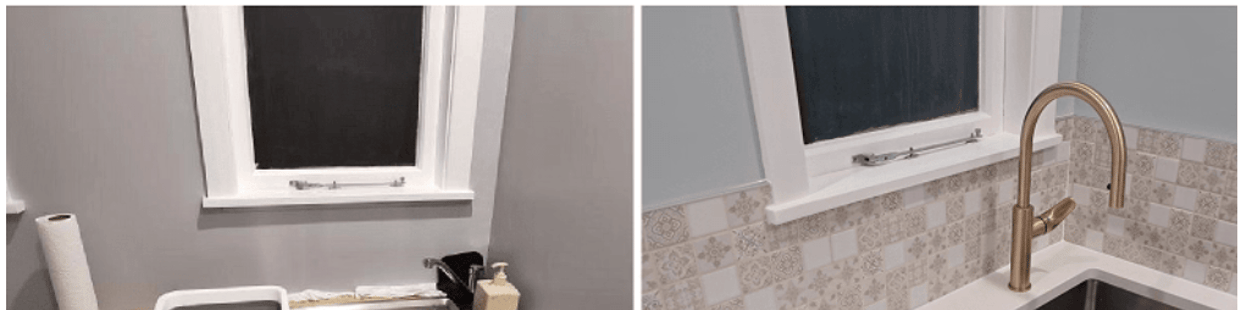
Our observation: Century-old out-of-plumb walls and uneven corners
When the Southerleigh team prepped the surfaces and mapped out the tiling grid, our technical evaluation revealed a classic character-home obstacle that would ruin a standard tiling job:
1. Walls and corners were out of plumb
Over the last 100 years, the house had naturally settled. The plaster walls and vertical corners were no longer straight or plumb, meaning they did not sit at a perfect 90-degree angle.
2. Straight tiles onto crooked spaces
When square tiles with perfectly straight edges are forced onto a wall that steps or leans, the grout lines will naturally begin to stagger and drift out of alignment. If installed without adapting to the building's movement, the regular outline of the tiles and intricate Spanish pattern would look visibly crooked against the kitchen benchtop and laundry cabinetry.
The solution: Precision layout mapping, custom cuts, and expert installation
To overcome the uneven walls and deliver a flawless finish, our team treated the installation as a custom puzzle, requiring meticulous planning before mixing any adhesive.
Micro-measurement and symmetry planning
We manually measured the warp of the walls and pre-planned the layout grid. In consultation with the client, this ensured that any slight variance in the 1920s framing was evenly distributed and completely invisible to the naked eye.
Painstaking custom tile cuts
Using precision wet-tile saws, we custom-profiled the edge tiles where they met the out-of-plumb corners of the splashback. Each tile was individually back-buttered to account for the slant and slight bulges of the walls while keeping the central geometric lines perfectly level and square.
Crisp grouting to lock in the pattern
Once the tiles were perfectly placed, we applied a crisp, contrasting grout to seamlessly bind the joints. This highlighted the unique Spanish artwork without distracting from the pattern's continuity.
The result: A flawless, show-stopping feature
The finished kitchen and laundry splashbacks looks immaculate. By taking the time to correct for the uneven walls rather than rushing the tile installation, we enabled the owner to create a beautiful and impactful feature wall in an otherwise plain space.
The client was thrilled, noting, "It's beautiful. I'll be happily looking at these tiles for years!"